How Do You Calculate Your One-Rep Max?

Your one-rep max (1RM) is the most weight you can lift once. You can test it, or estimate it from a set with a formula. The Epley formula is weight × (1 + reps ÷ 30), so 100 kg for 8 reps gives about 126.7 kg. Estimates are most accurate from sets of 10 reps or fewer.
What is a one-rep max (1RM)?
Your one-rep max, or 1RM, is the most weight you can lift for one full repetition of an exercise with good form. It belongs to one exercise: your bench press 1RM and your squat 1RM are two different numbers. Strength studies use it to measure strength, and many training programs set their loads as a percentage of it.
You can find it two ways: test it with a single heavy lift, or estimate it from a set of several reps with a formula.
Should you test your one-rep max or estimate it?
A test means warming up, then working up in single reps until you reach the heaviest weight you can lift once. Repeated tests give close results. A 2020 systematic review by Jozo Grgic and colleagues, of 32 studies with 1,595 participants, found good to excellent test-retest reliability, with a median variation of 4.2% between tests. That held with and without training experience, with and without a practice session, for men and women and for young and older adults.
A test is a maximal lift, and older adults may be more prone to injury at that intensity. In a 2011 study by Robert Gearhart and colleagues, 49 healthy men and women in their sixties found their 1RM using a perceived exertion scale to choose each weight, and no injuries were reported.
To judge how close an attempt is to your limit, a 2016 study by Michael Zourdos and colleagues tested a rating of perceived exertion (RPE) scale based on reps in reserve (RIR): RPE 10 means no reps left, RPE 9 means one rep left, and so on. The authors called it a practical way to regulate daily training load and to give feedback during a 1RM test.
An estimate skips the maximal lift. You do a set you can manage several times and put the weight and the reps into a formula. You give up some accuracy for that.
How do you estimate your one-rep max from a set?
- Warm up, then load a weight you can lift 10 times or fewer.
- Do one set of as many reps as you can with good form, and write down the weight and the reps.
- Put both into a formula. With the Epley formula, multiply the weight by 1 plus the reps divided by 30.
- Treat the result as an estimate: the more reps in the set, the further off it can be.
Every formula scales the weight up by the number of reps, each by its own rule. Four common ones, with the same set of 100 kg for 8 reps:
| Formula | How to calculate it | 100 kg for 8 reps |
|---|---|---|
| Epley | weight × (1 + reps ÷ 30) | 126.7 kg |
| Brzycki | weight × 36 ÷ (37 − reps) | 124.1 kg |
| Lombardi | weight × reps0.10 | 123.1 kg |
| O'Conner | weight × (1 + 0.025 × reps) | 120.0 kg |
From one set, the four give 120.0 to 126.7 kg, a gap of 6.7 kg. Epley adds a thirtieth of the weight for every rep, the first one included, so a single rep at 100 kg comes out at 103.3 kg.
How accurate is an estimated one-rep max?
Estimates get less accurate as the reps go up. In a 2006 study by Jason Reynolds and colleagues, 70 men and women aged 18 to 69 found their 1, 5, 10 and 20 rep maximums on the bench press and the leg press. The weight dropped off in a curve as the reps rose, 5-rep maximums predicted 1RM most accurately, and the authors concluded that no more than 10 reps should be used in linear equations. A 2003 study by Michael Whisenant and colleagues tested 11 prediction equations on 69 college football players benching 225 lb (about 102 kg), and the equations were more valid when fewer reps were done.
The best formula also depends on the exercise. In a 2011 study by Peter McNair and colleagues, of 18 people with knee osteoarthritis, the Brzycki, Epley and five other equations were the most accurate on the knee extension, with typical errors of 3 to 4%. On the leg press, four other equations did best, O'Conner's among them, with typical errors of 5.9 to 6.3%.
People differ too. A 2024 meta-regression by James Nuzzo and colleagues, of 269 studies with 7,289 people, found that the number of reps possible at a given percentage of 1RM varies between individuals and is higher on the leg press than on the bench press. Sex, age and training status seemed to make little difference.
Put the same set through all four formulas and the gap grows with the reps:
| Set | The four formulas give | Gap |
|---|---|---|
| 100 kg × 3 | 105.9 to 111.6 kg | 5.7 kg |
| 100 kg × 5 | 112.5 to 117.5 kg | 5.0 kg |
| 90 kg × 10 | 112.5 to 120.0 kg | 7.5 kg |
| 75 kg × 15 | 98.3 to 122.7 kg | 24.4 kg |
| 60 kg × 20 | 81.0 to 127.1 kg | 46.1 kg |
The 2006 study used sets taken to failure. A set you stop with reps in reserve shows fewer reps than you could have done, so the formula gives a lower number than your full set would have. None of the studies cited here tested estimates from sets stopped short of failure.
How do you use your one-rep max to choose training weights?
The American College of Sports Medicine (ACSM) writes most of the loads in its 2009 position stand as a repetition maximum (RM), the most weight you can lift a given number of times: 8 to 12 RM for beginners, and 1 to 12 RM for intermediate and advanced lifters, varied over time, with the emphasis moving to 1 to 6 RM for strength. For muscular endurance it gives a percentage: 40 to 60% of 1RM for more than 15 reps.
A formula converts between the two. Turned around, Epley says a weight you can lift 8 times is about 79% of your 1RM. From the estimated 1RM of 126.7 kg above:
| Reps you can do | Share of 1RM (Epley) | From an estimated 1RM of 126.7 kg |
|---|---|---|
| 3 | 90.9% | 115.2 kg |
| 5 | 85.7% | 108.6 kg |
| 8 | 78.9% | 100.0 kg |
| 10 | 75.0% | 95.0 kg |
| 12 | 71.4% | 90.5 kg |
Use the table as a starting point. In the 2024 meta-regression, the reps people could do at a given percentage varied from person to person, and between the leg press and the bench press. Once you have a working weight, progressive overload covers how to add to it.
How does Musklr calculate your estimated one-rep max?
Musklr uses the Epley formula. For every set you tick, it multiplies the weight by 1 plus the reps divided by 30, and the best set of the workout becomes that workout's estimated one-rep max. The best set is not always the heaviest one: 90 kg for 10 reps (120.0 kg) beats 100 kg for 3 (110.0 kg).
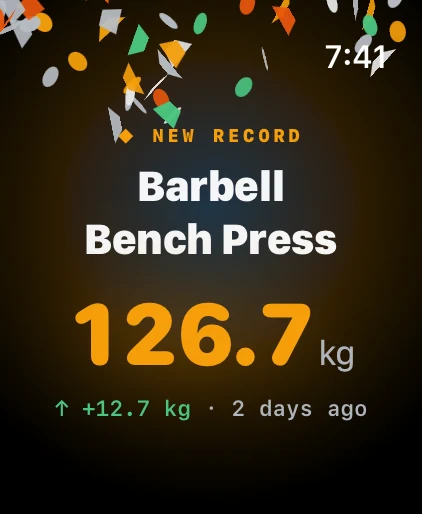
Each workout in an exercise's History tab shows its Est. 1RM, and the Progress tab charts Est. 1RM over time. Open Progress, then Exercises, and tap the exercise; the list there also shows each exercise's last est. 1RM. When a workout's estimate beats every earlier one, Musklr marks a new personal record, with a New Record! toast on iPhone and on your wrist on Apple Watch. In the picture, 100 kg for 8 reps works out to 126.7 kg, 12.7 kg more than the 114.0 kg from 90 kg for 8 two days before.
Musklr runs the formula at any number of reps, so read an estimate from a set of 15 or 20 reps with the gaps above in mind. A single rep gets Epley's extra thirtieth too: 100 kg for 1 shows as 103.3 kg.
The estimates, the history and the records are free. Free charts show the last month, and longer ranges need Pro, about $2.50 a month billed yearly.
Get Musklr free on the App Store
Frequently asked questions
Which one-rep max formula is the most accurate?
No formula is the most accurate everywhere. In a 2011 study of people with knee osteoarthritis, Brzycki, Epley and five other equations did best on the knee extension, while four others did best on the leg press. On reps, two studies point the same way: estimates were more accurate from fewer reps, and a 2006 study concluded that no more than 10 should be used in linear equations.
How many reps give the most accurate one-rep max estimate?
In a 2006 study of 70 men and women, 5-rep maximums predicted 1RM most accurately on the bench press and the leg press, and the authors concluded that no more than 10 reps should be used in linear equations. Above 10 reps, the common formulas drift further apart on the same set.
Is a one-rep max test reliable for people new to lifting?
Yes, according to a 2020 systematic review of 32 studies with 1,595 participants. It found good to excellent test-retest reliability for the 1RM test with and without training experience, and with or without a practice session first. The median variation between two tests was 4.2%.
Which one-rep max formula does Musklr use?
Musklr uses the Epley formula, weight × (1 + reps ÷ 30), on every set you tick. The best set of each workout becomes that workout's estimated one-rep max, shown as Est. 1RM in the exercise's history and chart, and a new best counts as a personal record.
Does Musklr show your estimated one-rep max for free?
Yes. The Est. 1RM of every workout, each exercise's history and personal records for estimated one-rep max are all in the free version of Musklr. The charts show the last month for free, and longer ranges need Pro.
Sources
- Grgic J, Lazinica B, Schoenfeld BJ, Pedisic Z. (2020). Sports Med Open 6(1):31. Test-Retest Reliability of the One-Repetition Maximum (1RM) Strength Assessment: a Systematic Review
- Gearhart RF, Lagally KM, Riechman SE, Andrews RD, Robertson RJ. (2011). Percept Mot Skills 113(2):671-676. Safety of using the adult OMNI Resistance Exercise Scale to determine 1-RM in older men and women
- Zourdos MC, Klemp A, Dolan C, et al. (2016). J Strength Cond Res 30(1):267-275. Novel Resistance Training-Specific Rating of Perceived Exertion Scale Measuring Repetitions in Reserve
- Reynolds JM, Gordon TJ, Robergs RA. (2006). J Strength Cond Res 20(3):584-592. Prediction of one repetition maximum strength from multiple repetition maximum testing and anthropometry
- Whisenant MJ, Panton LB, East WB, Broeder CE. (2003). J Strength Cond Res 17(2):221-227. Validation of submaximal prediction equations for the 1 repetition maximum bench press test on a group of collegiate football players
- McNair PJ, Colvin M, Reid D. (2011). Arthritis Care Res (Hoboken) 63(2):216-222. Predicting maximal strength of quadriceps from submaximal performance in individuals with knee joint osteoarthritis
- Nuzzo JL, Pinto MD, Nosaka K, Steele J. (2024). Sports Med 54(2):303-321. Maximal Number of Repetitions at Percentages of the One Repetition Maximum: A Meta-Regression and Moderator Analysis of Sex, Age, Training Status, and Exercise
- American College of Sports Medicine. (2009). Med Sci Sports Exerc 41(3):687-708. American College of Sports Medicine position stand. Progression models in resistance training for healthy adults
This article is general information about training and is not medical advice.
Log your next workout in Musklr
Musklr is free on the App Store and has no ads. Log a set in two taps on iPhone or Apple Watch.
