What Is Progressive Overload, and How Do You Track It?

Progressive overload means making your training a little harder over time, with more weight, more reps or more sets. The ACSM recommends adding 2 to 10% to the load once you can lift it for one or two reps more than your target. To track it, log each set's weight and reps and beat one number next time.
What is progressive overload in strength training?
Progressive overload means making your training harder over time, so your body keeps having something to adapt to. The American College of Sports Medicine (ACSM) states in its 2009 position stand on progression that progressive resistance training is needed to keep adapting toward a training goal. A 2004 review by William Kraemer and Nicholas Ratamess describes progression as changing the load, the reps, the sets and the rest over time to keep moving toward a goal.
In practice you look at what you did last time on an exercise and try to beat one number: the weight, the reps or the number of sets.
What are the ways to apply progressive overload?
Adding weight is the best known way. The research supports adding reps and sets as well, and the table lists each with an example.
| Way to progress | Example | What the research found |
|---|---|---|
| More weight | Bench press 60 kg to 62.5 kg for the same 8 reps | The ACSM recommends 2 to 10% more load once you can do one or two reps more than your target (ACSM 2009) |
| More reps at the same weight | 60 kg for 8 reps, then 9, then 10 | About as effective as adding weight over 8 weeks in trained lifters, on leg exercises (Plotkin 2022) |
| More sets | 3 sets to 4 sets | More weekly sets went with more muscle growth, in a graded dose-response (Schoenfeld 2017) |
| A planned change of exercise | Back squat to front squat after a block of training | Some systematic variation seems to help; changing exercises too often may hold gains back (Kassiano 2022) |
| Shorter rest or slower reps | Rest cut from 2 minutes to 1 | Makes a set harder without more weight, reps or sets. None of the studies cited here tested it as a way to progress |
In a 2022 study, Derrick Plotkin and colleagues randomly assigned 43 lifters with at least a year of training to add weight at a fixed number of reps or to add reps at a fixed weight, on four leg exercises twice a week for 8 weeks. Both groups gained muscle and strength. Growth at the front of the thigh slightly favored adding reps, and strength slightly favored adding weight. The authors called the differences of questionable practical significance.
Your goal can decide between the two. A 2017 meta-analysis of 21 studies by Brad Schoenfeld and colleagues, in which every set went to muscular failure, found larger gains in one-rep max strength with heavy loads, and similar muscle growth with light and heavy loads. For maximal strength, the weight is the number to push. For muscle size, adding reps works too.
Adding sets counts as well. A second 2017 meta-analysis by Schoenfeld and colleagues, of 15 studies, found that each extra weekly set went with a little more muscle growth. How many sets per muscle a week is a question of its own.
How much weight should you add for progressive overload?
The ACSM position stand recommends raising the load by 2 to 10% when you can lift the current weight for one or two reps more than your target. Aiming for 8 reps on a 60 kg bench press, you would add weight once you get 9 or 10 reps. Two to 10% of 60 kg is about 1.2 to 6 kg. With a 1.25 kg plate on each side, the step is 2.5 kg, about 4%.
For beginners, the same position stand recommends loads you can lift for 8 to 12 reps. For intermediate and advanced lifters it recommends a wider range of 1 to 12 reps, varied over time in a planned way, with the emphasis on heavy loads of 1 to 6 reps when the goal is strength.
On small exercises, the smallest weight step can be a big jump. Going from a 10 kg to a 12 kg dumbbell on lateral raises is a 20% jump, well past that range, so on exercises like these, adding reps before weight keeps each step smaller.
What should you do when progressive overload stalls?
Look at your log first. If the reps at a weight are still rising, you are still progressing, and the 2022 study counted that as progressive overload. When the numbers have stopped moving, the research points to a few options:
- Add reps at the weight you have. In the 2022 study, that worked about as well as adding weight.
- Add a set. More weekly sets went with more muscle growth in the 2017 dose-response meta-analysis.
- Change the exercise on a plan. A 2022 review by Witalo Kassiano and colleagues, of eight studies in young men, found that some systematic variation in exercises seems to help, while changing exercises too often may hold gains back.
- Vary the load over the weeks. For intermediate and advanced lifters, the ACSM recommends training across 1 to 12 reps in a planned, periodized way.
How do you track progressive overload?
Write down the exercise, the weight and the reps of every set, with the date. Before the first set of an exercise, look at last time and pick the number to beat. Over the weeks, the log shows whether the weight, the reps or the sets are moving.
Keeping the record may help in itself. A 2016 meta-analysis by Benjamin Harkin and colleagues pooled 138 randomized studies with 19,951 participants and found that helping people monitor their progress toward a goal helped them reach it, more so when the progress was physically recorded. The studies covered many kinds of goals, not training in particular.
A notebook or a spreadsheet can do the job. How to track workouts at the gym compares a notebook, a spreadsheet and an app.
How does Musklr track progressive overload?
Every set row in a Musklr workout has a Previous column with the weight and reps from the last time you did that set, and the kg and reps fields start filled in with those numbers. To progress, raise the weight or the reps before you tick the set.
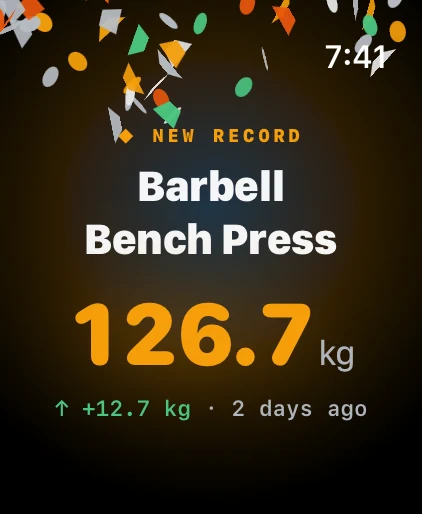
When a workout beats your earlier best on an exercise for estimated one-rep max, heaviest weight, volume or total reps, Musklr marks a personal record. On iPhone, a New Record! toast shows the record and how much you gained on your previous best, and the set's check mark turns into a trophy. On Apple Watch the record shows on your wrist. When you finish, the workout summary shows each record again, in a New records card on iPhone. The first workout of an exercise sets no record, because there is nothing to beat yet.
Each exercise keeps every past workout in its History tab, and its Progress tab charts estimated one-rep max, volume and total reps over time. Open Progress, then Exercises, and tap the exercise. The Previous column, history and personal records are free. Free charts show the last month, and 3 months, 6 months, a year and all time need Pro, about $2.50 a month billed yearly.

Get Musklr free on the App Store
Frequently asked questions
Is adding reps as effective as adding weight for progressive overload?
In a 2022 study of 43 trained lifters, adding reps at the same weight built muscle and strength about as well as adding weight over 8 weeks. Growth slightly favored adding reps and strength slightly favored adding weight, differences the authors called of questionable practical significance. The study used leg exercises only.
Do you need to add weight every workout for progressive overload?
No. One more rep or one more set is also progression. The ACSM recommends raising the load by 2 to 10% once you can lift the current weight for one or two reps more than your target, so several workouts can pass at one weight while the reps climb.
How should beginners apply progressive overload?
The ACSM position stand recommends that beginners use loads they can lift for 8 to 12 reps, and add 2 to 10% to the load once they can do one or two reps more than their target. A log of every set's weight and reps shows when that point arrives.
Does Musklr track personal records for free?
Yes. Personal records, each exercise's history and the Previous column with last time's weight and reps are all in the free version of Musklr. Its charts show the last month for free, and longer ranges need Pro.
How does Musklr show what to beat in the next workout?
Every set row in a Musklr workout has a Previous column with the weight and reps from the last time you did that set, and the fields start filled in with those numbers. Raise the weight or the reps before you tick the set, and Musklr marks a personal record when you beat your best.
Sources
- American College of Sports Medicine. (2009). Med Sci Sports Exerc 41(3):687-708. American College of Sports Medicine position stand. Progression models in resistance training for healthy adults
- Kraemer WJ, Ratamess NA. (2004). Med Sci Sports Exerc 36(4):674-688. Fundamentals of resistance training: progression and exercise prescription
- Plotkin D, Coleman M, Van Every D, et al. (2022). PeerJ 10:e14142. Progressive overload without progressing load? The effects of load or repetition progression on muscular adaptations
- Schoenfeld BJ, Grgic J, Ogborn D, Krieger JW. (2017). J Strength Cond Res 31(12):3508-3523. Strength and Hypertrophy Adaptations Between Low- vs. High-Load Resistance Training: A Systematic Review and Meta-analysis
- Schoenfeld BJ, Ogborn D, Krieger JW. (2017). J Sports Sci 35(11):1073-1082. Dose-response relationship between weekly resistance training volume and increases in muscle mass: A systematic review and meta-analysis
- Kassiano W, Nunes JP, Costa B, Ribeiro AS, Schoenfeld BJ, Cyrino ES. (2022). J Strength Cond Res 36(6):1753-1762. Does Varying Resistance Exercises Promote Superior Muscle Hypertrophy and Strength Gains? A Systematic Review
- Harkin B, Webb TL, Chang BP, et al. (2016). Psychol Bull 142(2):198-229. Does monitoring goal progress promote goal attainment? A meta-analysis of the experimental evidence
This article is general information about training and is not medical advice.
Log your next workout in Musklr
Musklr is free on the App Store and has no ads. Log a set in two taps on iPhone or Apple Watch.
